
Satellite tagging reveals vital migration data to strengthen Red Sea ecosystem-wide conservation.
Prince Mohammed bin Salman Royal Reserve has launched a landmark live satellite tracking program for Hawksbill and Green turtles, including the first known tagging of a pre-nesting, egg-carrying Green turtle in the Red Sea. The initiative aims to close critical knowledge gaps surrounding the movements of these globally endangered species and support unified, cross-border conservation strategies.
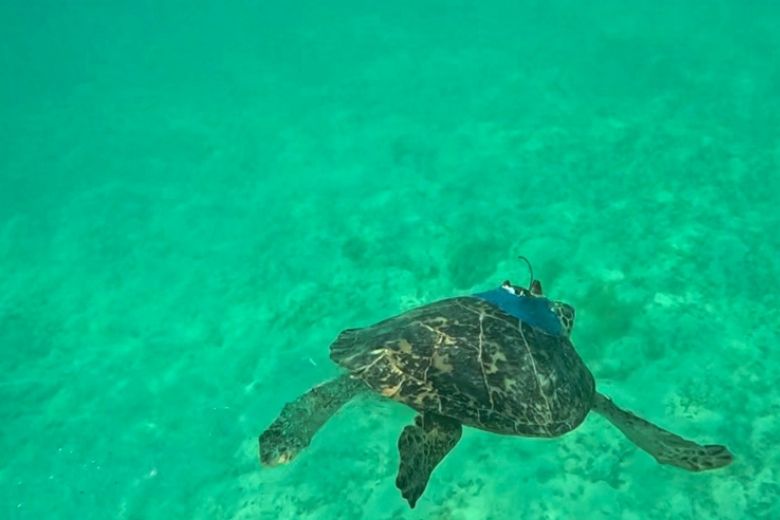
Led by Dr. Ahmed Mohammed, Senior Marine Ecologist at the Reserve, in collaboration with Dr. Hector Barrios-Garrido, Senior Marine Megafauna Specialist at KAUST Beacon Development, the team successfully captured and tagged three Critically Endangered Hawksbill turtles and seven Green turtles. The satellite tags provide real-time data that pinpoint foraging grounds, migration corridors, and, importantly, the nesting site of the egg-carrying Green turtle allowing targeted protection and management. This effort builds on the Reserve’s expanded turtle nest monitoring and protection program, active since 2023.
Real-time data identifies key migration corridors
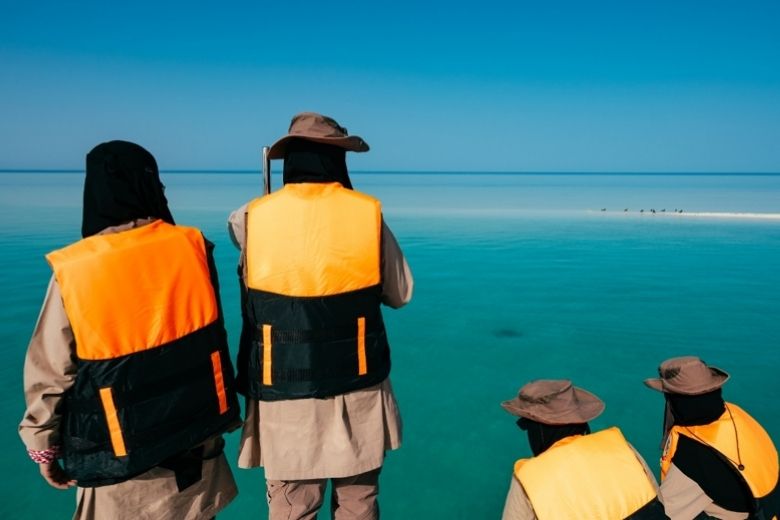
The Reserve manages 4,000 km² of Red Sea waters, 1.8% of the Kingdom’s marine area and oversees 170 km of coastline, the longest managed by any single entity in Saudi Arabia. Together with the protected coasts of NEOM and Red Sea Global, this forms an uninterrupted 800 km conservation corridor. The area serves as a refuge for five of the world’s seven marine turtle species and is a critical breeding ground for both Green and Hawksbill turtles. Ranger teams closely monitor offshore and onshore turtle activity, safeguarding nesting beaches essential to natal homing, the instinct that drives turtles to return to the beach where they hatched.
“Critically Endangered Hawksbill turtles face an extremely high risk of extinction in the wild within our lifetime. With fewer than 200 breeding-age females remaining in the Red Sea, their survival depends on closing vital knowledge gaps,” said Andrew Zaloumis, CEO of Prince Mohammed bin Salman Royal Reserve. “Hawksbill turtles hatching on the Reserve’s protected beaches travel across 438,000 km² of open sea bordered by eight MENA countries before returning decades later to nest. Our satellite tagging program is a game changer, giving us the real-time information needed to identify key staging, foraging, and rookery areas across the Red Sea and to support unified, ecosystem-wide conservation management.”
The program reinforces Saudi Arabia’s commitments under the UNEP Convention on Migratory Species and the IOSEA Marine Turtle Memorandum of Understanding, strengthening habitat protection and regional collaboration through science-based knowledge-sharing.
According to Dr. Mohammed, the lightweight satellite tags are designed to operate for at least 12 months. “These tags will provide continuous data to help us understand seasonal movements, developmental habitats, and ecological patterns. The depth sensors will also reveal sea grass meadows, critical foraging areas for Green turtles and important blue carbon sinks,” he said.
Although the IUCN recently reclassified Green turtles globally, they remain regionally Vulnerable and conservation-dependent. All five marine turtle species found in the Red Sea are listed under the Convention on Migratory Species, to which Saudi Arabia has been a Party since 1979. While threats such as entanglement, habitat degradation, and poaching are absent within the Reserve’s protected waters, turtles’ wide-ranging migrations demand ecosystem-wide conservation efforts that transcend national boundaries. The Reserve continues to share data with regional partners, including SHAMS, to support coordinated conservation strategies.
About Prince Mohammed bin Salman Royal Reserve
Covering 24,500 km² from the volcanic Harrat plains to the Red Sea, the Reserve connects NEOM, Red Sea Global, and AlUla, and includes PIF’s Wadi Al Disah project and Red Sea Global’s Destination AMAALA. Despite representing only 1% of Saudi Arabia’s land area and 1.8% of its marine area, it contains over 50% of the Kingdom’s species, making it one of the most biodiverse protected areas in the Middle East.
The Reserve is committed to restoring natural and cultural heritage through an ambitious rewilding program that aims to reintroduce 23 native species, 11 of which, including Arabian oryx, Persian onager, sand gazelle, and mountain gazelle, have already been successfully reintroduced. Overseen by the Royal Reserves Council and aligned with the Saudi Green and Middle East Green Initiatives, the Reserve plays a central role in advancing national sustainability objectives.
 Arabic
  English